

AI Can Only Be Built on Stable Foundations: Key Takeaways from the First Connected Commerce Meetup
Smart planning, thorough business-process discovery, and already stable back-office systems must come before adopting AI and automation. Without them, AI and digital transformation create operational chaos instead of scalable efficiency. Among other things, these were the core findings of the first Connected Commerce Meetup, co-organized by Color and Code and msg Plaut Hungary, featuring enterprise technology leaders SAP and Shopify.
In recent years, it has become increasingly clear that customer experience is one of the most important competitive advantages, and shoppers will seriously penalize merchants for even a single negative experience. According to Salesforce research, 53% of customers would consider switching to a competitor after just one bad experience, with the figure being roughly the same among B2B and B2C customers.
Merchants face rising customer expectations, while digital channels are also evolving rapidly and the boundaries between different commerce channels continue to blur. Today’s buyers expect a unified, omnichannel experience, something mid-market and enterprise organizations can achieve only through seamless integration of their underlying IT systems.
Connected Commerce is the answer to this structural challenge, which is why our private industry meetup focused on its real-world execution. Below are the key insights from the four presentations.
Henry Chen: Spending on Growth Rather Than Maintenance

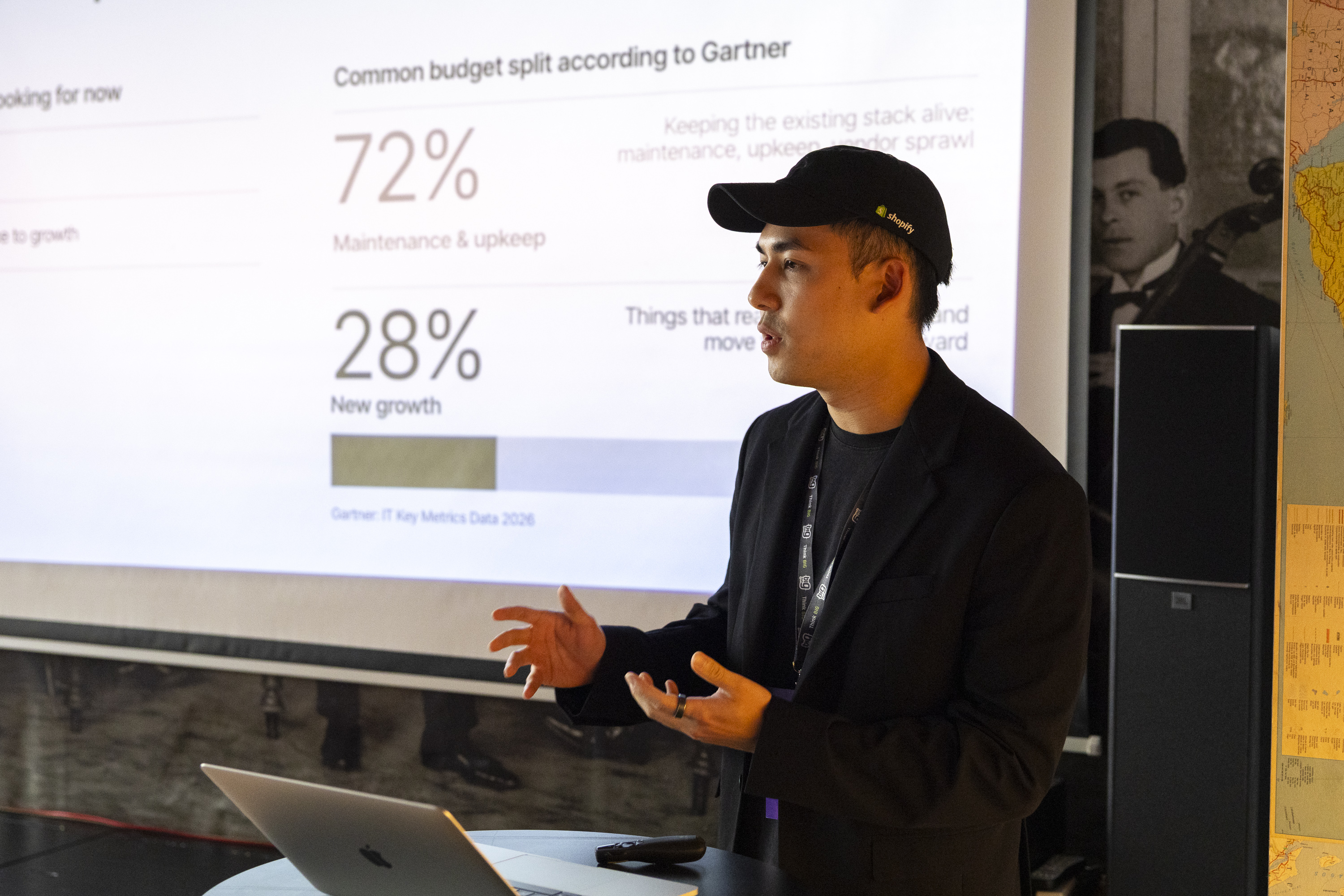
One of our most important guests was Henry Chen, a Shopify expert, who spoke about how much merchants can benefit from an e-commerce system that is capable of continuous development and innovation. As he explained, according to Gartner’s 2026 research, a significant share of the average enterprise IT budget (72%) goes simply toward maintaining existing systems and keeping them running, while only 28% is spent on actual growth and improving the customer experience. Shopify can take this burden off the shoulders of e-commerce businesses looking to grow.
Chen also shared some other figures about the e-commerce platform:
- Significant development budget: With an annual development budget of $1.5 billion and more than 300 new features released every year, merchants don’t have to develop every new feature themselves, including payment, international commerce, and AI integration solutions.
- Unified data model: In a well-designed system, products, orders, customers, and inventory all live in one central system, allowing different channels, including POS, online stores, B2B, social media, and AI agents, to connect natively.
- Built-in artificial intelligence: AI-powered catalogs achieve twice the conversion rate of copied data, while daily active usage of the Sidekick AI assistant increased 3.6x in a single year.
- Reliability and experience: The platform has been operating for more than 20 years, serves millions of merchants across 175+ countries, and powers more than 14% of e-commerce in the United States.
Gábor Varga: Growth starts with getting your systems in order
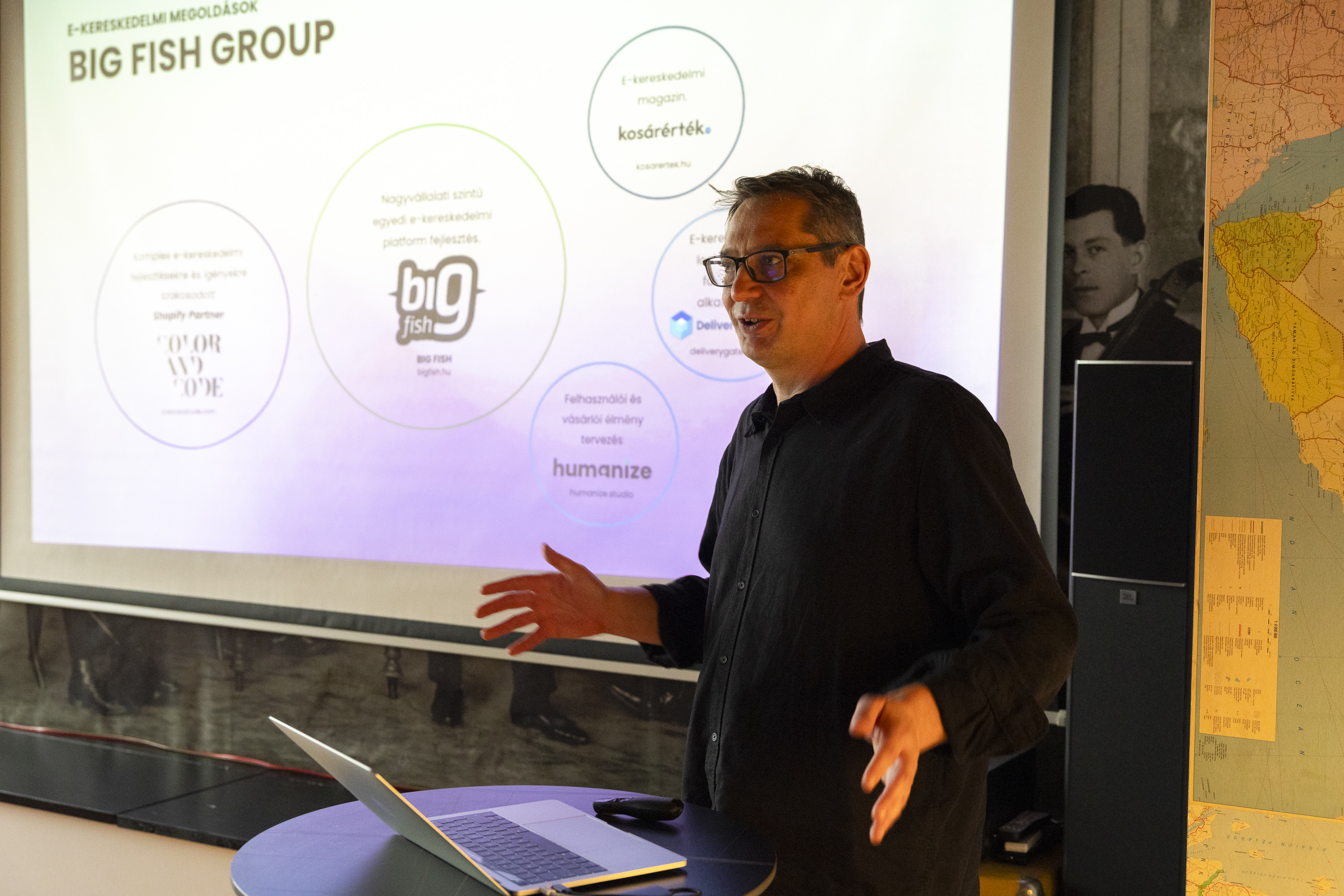
Gábor Varga, CEO of Color and Code, approached platform migration from the perspective of complex e-commerce development and enterprise integrations. He emphasized that no two companies are the same, and beyond a certain size and level of complexity, this requires serious, custom system integration. This is exactly when the expertise of agencies like Color and Code comes into play: they are able to connect different systems seamlessly.
He also shared what businesses should consider before starting a project like this:
- Fast start vs. planning: Shopify’s AI features make it quick and easy to enter (international) markets, but as a business grows, serious IT planning becomes increasingly important.
- There’s no way around integration: The real challenge is therefore to integrate the online store organically into the company’s overall operations, together with its ERP and other systems.
- Defining responsibilities is key: An important principle is that every piece of data should have a single source of truth, helping to avoid data chaos. This is why, already in the planning phase of development, it is essential to define which data comes from which system and which system is responsible for handling it. This way, the integration layer only needs to transport data rather than make business decisions.
- A stable backend is the foundation for AI: Automation and the effective implementation of AI should only come after the foundations of system integration are stable. Otherwise, AI will also operate based on incorrect data and only add to the chaos.
Anett Szalai: Establishing System Boundaries and Data Ownership

According to Anett Szalai of msg Plaut Hungary, SAP and Shopify can complement each other well, but Connected Commerce starts with decisions, not integration. The two platforms now arrive at the same SME customer from two different directions, so it must be clear from the start who is the master of what. These decisions should not be based solely on current needs; instead, they should follow a roadmap mindset: developers and the client should work together to determine where each function belongs, taking the company’s future direction into account.
What should be clarified before integration begins:
- Five questions before anything gets started: Partners, pricing, orders, inventory, and invoices. For each of these, it needs to be decided which system will serve as the single source of truth, because no system can operate reliably without clean data.
- Two systems, two roles: Ideally, responsibilities are clearly divided between the systems. Shopify provides a fast, customer-friendly interface, catalog, and checkout, while SAP handles operations and financial data in the background.
- Good planning saves time and money in the long run: With a properly implemented ERP and e-commerce system, total cost of ownership can be reduced by up to 33%, while time to market can be shortened by 20%. However, these benefits can only be achieved with proper planning.
- Revenue or actual profit: Sales naturally appear in both the e-commerce system and the ERP. However, SAP stores the financial and cost data needed to calculate profit. Understanding this distinction is essential for analyzing the data correctly.
Ferenc Mezei: AI Cannot Function Without Resilient Foundations

Ferenc Mezei, an SAP expert, explained that while AI and automation can take much of the day-to-day stress off merchants’ shoulders, for example by independently detecting and resolving an inventory shortage, they can only work safely if the company’s core processes and data are already in order. However, many AI solutions are added on top of existing systems without being deeply integrated into the company’s processes and data. This can lead to serious “misunderstandings” within the system.
The expert also explained the key characteristics of effective digitalization:
- The three pillars: A well-functioning, highly digitalized company is fundamentally built on three pillars: a reliable ERP foundation, a context-aware AI platform, and autonomous AI agents.
- It doesn’t just advise, it executes: A system like this, built on reliable data, makes it possible for AI not only to provide suggestions but also to independently execute tasks under human supervision.
- Proven in practice: With a well-designed system, AI can, for example, detect an inventory shortage, assess the available options, initiate replenishment in SAP, and log the outcome.
- Growth instead of stress: All of this allows merchants to focus on growth instead of spending their time on repetitive and stressful day-to-day tasks.
Integrated commerce is the future
As the experts made clear, connecting systems, data, and processes is playing an increasingly important role in the development strategies of both SAP and Shopify. Why? Because AI and data-driven decision-making are becoming more important in e-commerce, but they simply cannot work without high-quality, trustworthy data. This requires more carefully planned development than ever before. In fact, this kind of thoughtful approach and seamless synchronization is also at the heart of Connected Commerce.
This approach matters more than ever because data shows: one of customers' most common frustrations is not getting a consistent experience across companies, while 80% say the experience a company provides is just as important as its products or services.
Is Your Business Ready to Level Up?
If you think that your company has reached the point where siloed, disconnected systems are holding back growth and operational efficiency, reach out to us for a free consultation! At Color and Code, we specialize in designing, developing, and integrating complex e-commerce ecosystems for mid-market and enterprise businesses, from initial discovery and consulting through implementation. This is how we can achieve the best possible results and help your business take its sales operations to the next level.
Related posts

Related posts

We Are Looking for Clients Who Are Ready to Level Up - Announcing Strategic Partnership with msg Plaut

ICYMI: The biggest (Shopify) news of the year so far

Shopify Exec: The merchants who are ready for AI will have a significant advantage over those who aren't
Why do we recommend Shopify?
Shopify is one of the most scalable, feature-rich, and fastest-growing e-commerce platforms. Trusted by over one million e-commerce businesses in 175 countries worldwide, it provides the tools and flexibility needed to succeed in the digital marketplace.


Ideal solution for both Small and Large Businesses with high traffic